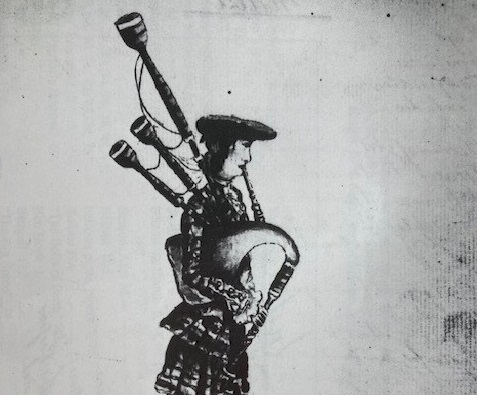
In 1760, Joseph MacDonald wrote a manuscript which he entitled A Compleat Theory of the Scots Highland Bagpipe. He was a piper himself, and as far as is known, the first piper ever to write on the subject or to attempt to record in notation form the music we now know as piobaireachd. The Clan Donald Trust’s prize for piobaireachd seeks to honor the memory of Joseph MacDonald. The word ‘piobaireachd’ literally means pipe playing or pipe music but is now used to describe the classical music of the Great Highland Bagpipe. Another name for it is ‘ceòl mór’ meaning ‘the big music,’ which separates piobaireachd from all other forms of pipe music (marches, reels, jigs etc.) which are referred to as ‘ceòl beag’ – the little music. To describe a piobaireachd is not easy. It consists of a theme or ‘ground’ with variations (which vary in number and complexity) that follow the theme. The theme is often very slow, and the general effect of the whole piece of music is slow – slowness being a characteristic of Highland music, though not, obviously, the dance music. Nothing resembling piobaireachd has been discovered in any other country in the world. Also, the Great Highland Bagpipe is the only instrument which can reproduce piobaireachd satisfactorily to the ear of the devotee.
The Robert Burns Society of Charleston Inc. is recognized as a 501(c)(3) non-profit organization committed to celebrating and sustaining Scottish-American heritage in the South Carolina Lowcountry. This commitment includes the promotion of historical awareness, cultural expression, and military traditions associated with Scotland. The Society fulfills its mission by hosting educational and cultural activities, supporting the mastery of traditional Scottish arts—such as Highland Bagpiping, Highland Dance, Scottish Fiddle, Scottish Harp (Clàrsach), and the Scots Gaelic language—and by providing grants and scholarships that support academic advancement within the Scottish-American community.
Membership Form